Posts

Showing posts with the label ITC

Randall and Hopkirk (Deceased): But What a Sweet Little Room

Image
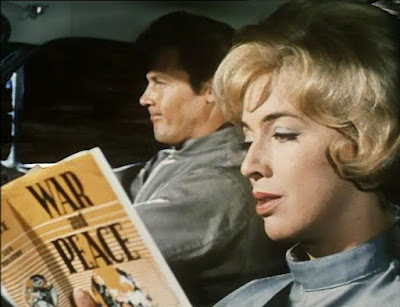
It's Fake Mediums Week on the blog! Lucky you none of you come here for sensible blogging, isn't it. Actually it's remarkable how things come to your attention in common themes. When I posted earlier this year about television plays it was remarkable how psychopathy came up and I wasn't even looking for it. Now in my viewing fake mediums have come up. There is of course a certain irony in there being a Randall and Hopkirk episode featuring a fake medium. I like the ones where people who aren't knowingly psychic or professional mediums can see Marty either all the time or under certain circumstances. On the other hand I suppose having a real ghost with you is a fairly certain way to weed out the fake mediums! We're still in classic ITC territory and I'm going to say it right now - for my money you can keep all the CGI in the world, there's nothing to compare to a good set and some back projection interspersed with some stock footage. I like my TV to be un...
The Saint: The Old Treasure Story

Image
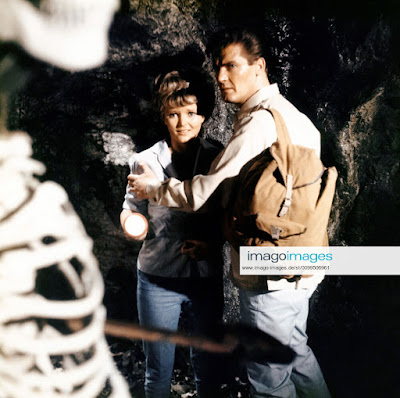
The great advantage of the gentleman adventurer televisual persona of Simon Templar is that the show could basically go anywhere or adopt any plot device, as long as there was a lounge for him to lounge around in. Here the show turns into a combination of Cornish-village-mystery and treasure-hunt-mystery. I suspect that this departure from the exotic scenes may not be so popular with the fans, but am not sure because I have strangely been able to find relatively little about this on online. In fact apart from a couple of websites specifically about the show (which as far as I can see are both in a process of building and haven't covered every episode) I do also wonder why there's relatively little about The Saint online. Don't get me wrong - there's not nothing, but when you google most episodes of most cult TV shows of this era you find a number of familiar websites blogging about them and you don't get that for The Saint. I can't think why - honestly these epi...

The Saint: Sophia

Image
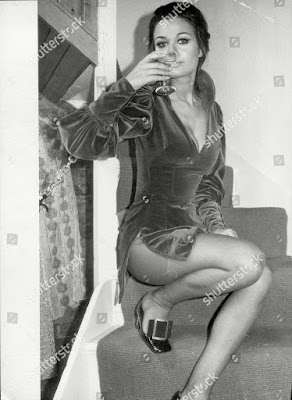
Back in much more classic Saint territory here, for an episode set on a Greek island, although very obviously actually filmed in Elstree! As always I read around other people's opinions on the show before getting as far as writing a post, with the intention of writing something different to what's already out there and getting a sense of what people think. Most of the commentary on this episode is dominated by Oliver Reed and Imogen Hassall and interestingly they completely overpower any comment on the actual show. To me this episode is the perfect example of why using big names is not conducive to good TV. There are a few other things to say about it, firstly that this show reminded me of how much the TV of this era fed into British jingoism, largely because I suspect a lot of viewers would have watched this show and concluded that the behaviours and events it depicts were typical of Greeks, 'Continentals', as my aunt called them, or even foreigners full stop. The part...

The Saint: The House on Dragon's Rock and An Appeal

Image
I have so much planned in my head: series of posts on Hammer House of Horror and TV made in Birmingham, continuing my series of posts on Fury from the Deep, The Tomorrow People and The Avengers Series 1. So obviously that's why here is another post about The Saint. I can never actually guarantee what TV show will grab my attention. These later episodes of The Saint don't tend to be favourites of the fans, who are conditioned to expert endless globe trotting, international intrigue and Cold War conspiracies with dolly birds turning up at every airport. I do have some sympathy for them, but also can see that it's virtually impossible to keep that up for any length of time. After a time the fans then start complaining that you're doing the same thing, and really you can't win. Once you've portrayed Templar gadding about one sunny European resort it's a bit difficult to make the others different. I suppose Doctor Who would be the classic example of a show which ...

The Saint: The World Beater

Image
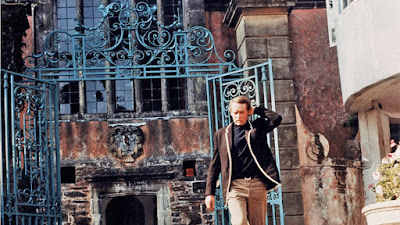
I started off watching this show thinking that it had been a long time since I had watched some ITC (I also have Randall and Hopkirk Deceased lined up to rewatch) before realising some time in that I have just finished a lengthy series of posts about probably the best known ITC series of all time. I wasn't sure about why I don't automatically think of The Prisoner as being an ITC series - although I think it doesn't have the things which I think are characteristic of ITC series. These would of course be the Avengersland setting, the cast of the exact same circle of actors who appear in all these shows, and a certain ITC colour palette. I'm not sure if it's Eastman, identical to the Eastman effect, or if I'm just being affected by rambling on about film. You can also usually rely on ITC to have some romance (I use that word to tone down what I actually mean) which was never on the agenda in The Prisoner. Anyway, I have only just noticed that I perceive a marked d...

The Prisoner in the Asylum: Conclusion

Image
The introduction and master post to this series of posts about The Prisoner can be found  here . And so we've reached the end of this series of posts about The Prisoner being interpreted as being about mental health or The Village being a very special clinic, and I have some conclusions. My one regret or problem with this series of posts is that I think they are actually a book, and I'm in no fit state to put up with the reasonable expectations of publishers and the reading public these days so if anyone ever writes it, it won't be me. The area of psychiatry and psychological health in the middle of the twentieth century is a HUGE area which can be seen as referenced by this series in many ways in each episode. I chose to hang one or a few subjects about mental health on each episode as they related to it. I think this mainly worked, although I think a book length account would require a general overview of what was going on in psychiatry followed by an exhaustive account o...

The Prisoner in the Asylum: Fall Out

Image
The introduction and master post to this series of posts about The Prisoner can be found  here . Welcome to the most lively discharge meeting in world history! The recap of Once Upon a Time which begins this episode allows us to refresh our memories of what I have interpreted as therapy sessions which have led up to this point. I am however painfully reminded that Number 2 talks about degree absolute (decree absolute?) which sounds like a divorce using the language of marriage (for better or worse, till death us do part), and contains the same mixture of affectionate talk and violence that we saw in The Girl Who Was Death. I am therefore hearing the same mixture of violence, lack of boundaries, incest and just plain abuse that I have read here before. A possible simple interpretation of this episode in psychiatric terms would be that it depicts a very unwell person's inner world and also an absconsion from hospital of several patients. You could interpret it that way if you want th...

The Prisoner in the Asylum: The Girl Who Was Death Part 2

Image
The introduction and master post to this series of posts about The Prisoner can be found  here . In my last post I considered some of the possible interpretations, mainly with a psychiatric bias, of this episode. Now we come to the final possible interpretation I suggested. (6) Symbolism The episode begins by showing us the story book and so clearly suggests that what we are about to see may not be strictly speaking true. However this is one of the episodes of the show which is most full of symbols which can represent other things and a number of totally bizarre experiences, so it clearly isn't intended simply to be taken aa an entertaining story. I would suggest that one of the reasons this episode comes late in the run and lacks a set interpretation for the symbols and narrative, is that we are being invited to interpret them for ourselves. You've got it, exactly as in therapy. However I want to go through some of the symbols and tie them up to other things mentioned in the s...

The Prisoner in the Asylum: The Girl Who Was Death Part 1

Image
The introduction and master post to this series of posts about The Prisoner can be found  here . Warning : this post includes mention of traumatic experiences which some readers may find distressing. There are a number of ways of taking The Girl Who Was Death (at least for the purposes of this blog post) and I will touch on all of them during this post so I'll have to begin by listing them in the hope that readers will have some map for where I'm going. They are that: (1) Number 6 is psychotic and hallucinating all this without the aid of psychedelics; (2) Number 6 is paranoid; (3) Number 6 is still stoned on LSD from Living in Harmony and this is a hallucination which may form part of LSD therapy; (4) this is a story (which may or may not tell the ongoing story of the dangers of the Village); (5) the episode may represent a therapy session where Number 6 talks about a number of traumas; (6) the episode may represent a number of symbols which give clues to the meaning of the sh...

The Prisoner in the Asylum: Living in Harmony

Image
The introduction and master post to this series of posts about The Prisoner can be found  here . When I wrote about  A, B and C I commented that sometimes that is taken to refer to psychedelic drugs but instead I took the approach that it could refer to ether abreaction. The reason I did that was that I already had the psychedelic experience marked down for this episode, and in fact didn't have much choice in the matter because the episode actually says it is a drug-induced experience fuelled by a Western town set that has somehow appeared next to the Village but nobody has remarked on it up until now. Surprisingly there are a few other things in this episode touching on mental health which I must just mention. The Kid suggests a type which has largely disappeared from our society except for in the tarot deck, namely the fool, or the holy fool. You would of course be quite right that he comes across here as much more psychopathic but to end up being a holy fool you have to ha...

The Prisoner in the Asylum: Do Not Forsake Me, Oh My Darling

Image
The introduction and master post to this series of posts about The Prisoner can be found  here . As I suspected, the later episodes of the show are giving me more trouble to apply a psychiatric explanation, despite being increasingly off the wall, and in fact this one is probably going to be the most difficult of the entire series. The reason for that is that there are several different things going on and it is possibly they're not all real, so I'll make a few suggestions about the episode and let you think about it rather than being my normal dogmatic self. The first possibility is that there is a warning about the perceived power of psychiatry in the Amnesia Room. It remains the stuff of conspiracy theories but no doubt there are some people somewhere who think psychiatrists have the technology to wipe your brain completely and let you go off as a happy robot. The second possibility is a therapeutic allegory about being who you are and not being other people. Despite what he...

The Prisoner in the Asylum: Many Happy Returns

Image
The introduction and master post to this series of posts about The Prisoner can be found  here . Applying a mental health/illness explanation to The Prisoner is in a sense dead easy, because you have the ultimate get out of jail card: if something doesn't fit your narrative you can just say it isn't real and is part of Number 6's own mental state. I was tempted to suggest one of the more traumatised diagnoses such as hysterical conversion for him, but decided that that would make it too complicated (for me, that is - conversion disorder is an utter nightmare to get your head round although I expect you, my readers, could) so a personality disorder with possibly a side helping of psychosis it was. I think these are best adapted to the show's discussion of society, responsibilty, etc. Anyway, that is all a preamble to me saying that the events of Many Happy Returns are very obviously not real. While I don't doubt the ability of the Village authorities to drug Number 6...

The Prisoner in the Asylum: Hammer into Anvil

Image
The introduction and master post to this series of posts about The Prisoner can be found  here . This is the one where Smith/Number 6 makes Number 73 kill herself. Read that again. Seriously, he made her kill herself. If you watch the sequence and forget the narrative that The Village is bad and Number 6 is the innocent prisoner it looks very diferent. If Smith hadn't been interfering in somebody else's treatment he wouldn't have had to have been restrained by the attendants and they could have been restraining Number 73 to stop her throwing herself out of the window. Number 6's sabotage of The Village, his own treatment and Number 73's treatment directly caused this. He has even managed to persuade everyone that he is the victim here! It is quite literally the truth when Number 2 tells him he shouldn't have interfered but of course he blames Number 2 for this. I'm not advocating slapping patients as Number 2 does, obviously. He has been pushed by Smith into...