Posts

Showing posts with the label Allegory in The Prisoner

Allegory in the Prisoner: Fall Out

Image
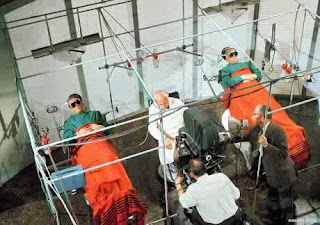
I notice when I watched through The Prisoner looking to identify Number 6 as John Drake, I identified Fall Out as a flawed episode. This time I would go further: when watched from the point of view of allegorical interpretation Fall Out is the episode that makes The Prisoner fall apart. Bearing in mind that the key allegorical interpretation of The Prisoner is of The Village as society, with reference to the various institutions etc, & their ability to harm us, it is capable of incredibly countercultural interpretations, as I think has been apparent in previous posts in this series. Fall Out makes this allegory unsustainable by turning it round to the pursuit of the individual's self-actualisation, or whatever you want to call it. 'We thought you would feel happier as yourself' are the words at which it becomes apparent we're in completely different territory here. It is still open to allegorical interpretation, just differently: here The Village becomes the mea...

Allegory in The Prisoner: Once Upon A Time

Image
You'll notice I've gone back to my original profile picture; it marks for me that I am no longer too shy to bare my chest. Also a friend tried to tell me nobody would believe it was really me. It is really me. So sorry. The end of this look at allegory is nearing with this episode, & you would be forgiven for thinking that I've rather lost my relish for the subject as I've gone through. What I was expecting to find was that the series was susceptible to numerous different allegorical interpretations, which it is in certain places. However I'm expecting my conclusion to be that some episodes lend themselves to an allegorical interpretation better than others. Notoriously not even McGoohan knew how the series would end while it was being filmed, & additional conflict about the number of episodes/series shows in a certain lack of direction as the series progresses, in my opinion. Additionally in my inner INFJ world of making connections I've been distra...

Allegory in The Prisoner: The Girl Who Was Death

Image
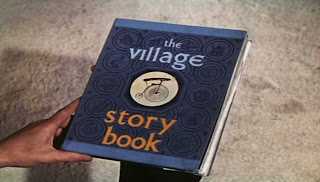
Since the focus of this series of posts is allegory, I'm quite keen to make everything in the episodes refer to something else if I possibly can. The Girl Who Was Death is another of those episodes which apparently take us out of the claustrophobic world of The Village. It is certainly one of my favourite episodes & seems to be beloved of the fans. But I must start by demolishing the way this episode is normally approached. If you actually watch the opening few minutes, it is apparent that Number 6 has woken up in The Village again. This episode is therefore set in The Village. Similarly the scenes with the story book are so brief as to be easily missed - or at least overlooked if you're not paying attention - & clearly indicate the point made so often in The Prisoner, that nothing is real, & the show is entirely focussed on The Village when it comes down to it. In a sense, it's a reverse allegory, where everything outside of it refers in some way to The Vil...

Allegory in The Prisoner: Living in Harmony

Image
Usually, when I start my dissection of a defenceless classic TV programme, I have a read round on the internet to see what other people have to say about it. In terms of the shows I've talked about so far, this is particularly easy in the case of The Avengers & The Prisoner, but seemingly not when it comes to Living in Harmony. I ended my piece on Do Not Forsake Me Oh My Darling by saying that I had no idea what I would do when I got to this episode. One of the things I'm finding useful about going through The Prisoner thematically, is I'm finding I watch the episodes in different ways - I would like to say the episodes lend themselves to different interpretations - & Living in Harmony is one that doesn't seem to attract much in the way of allegory. So let me invent the phrase argumentum a silentio for how I must start here: either this episode doesn't lend itself to allegory or the idea of an allegory of an allegory in an already allegorical show is just...

Allegory in The Prisoner: Do Not Forsake Me Oh My Darling

Image
Right. This is where I really get to go to town on my own theories with allegory in The Prisoner. Of course this is the odd episode out. Of course McGoohan is barely seen, & the wole episode isn't very 'McGoohan' at all. The majority of the episode even takes place outside of The Village. These are all the things that make this episode...I can only use the phrase 'stand out' from the rest, & it is the aspects that make people dislike this episode that must be grasped onto for the meaning here. The episode opens with a unique opener of men looking at transparencies. Much is made of slide Number 6. I'm not going to labour the wholly obvious point there. The presence of the great & the good & photography introduce the allegorical themes of this episode. It is about intelligence/technology (I suppose what we would now call information technology), & it is about power. The key intelligence here is the knowledge Selzmann has developed of trans...

Allegory in The Prisoner: A Change of Mind

Image
Image credit: http://v4valentine.tripod.com/SPP/MA0102_Index.htm It's a Soviet propaganda poster about fearing enemies of the people. I was astonished when I came to watch this episode again, to find I not only had no recollection of my blog post about it earlier this year, but I even had the impression it was the episode borrowed from the projected Series 2, where Number 6 becomes someone else in a job outside of the village. I'm intrigued that I focussed on the sheer pretence of everything that happens in the Village ( http://culttvblog.blogspot.de/2014/01/the-prisoner-change-of-mind.html?m=1 ). I had already started this post with the lengthy quote below, not realising that I'd already used a shorter version of it in my previous post: 'A lot of The Prisoner is about the individual versus the collective. This episode was probably the most Orwellian. Prisoners can't just suffer their imprisonment. They cannot be depressed or in any other way unhappy. They must...

Allegory in The Prisoner: It's Your Funeral

Image
Not a favourite of the fans, this one, although it is one of my own, except when it comes to trying to be creative about the allegory here! I keep trying to get away from the standard allegorical interpretation of The Prisoner, that The Village is an allegory for what is (or was in the 1960s) becoming of our world, particularly trying to escape into my own cherished theory that The Village is both Number 6's own creation & represents his dream of escape from the high-pressure world of his intelligence or espionage job. This is also one of the Prisoner episodes which have been rather overtaken by technology, & their warning has become more frightening in the process. The activity prognosis on Number 6 represents an omniscient knowledge of all variants in The Village, to the extent that an unexpected variation can be predicted. This was of course decades before the advertisements on the internet were tailored to our individual shopping habits & everywhere we go online ...

Allegory in The Prisoner: Hammer into Anvil

Image
I was wondering how on earth I was going to get a convincing allegorical meaning out of this episode. I was making the mistake of thinking that the plot could be summarised as 'Number 6 sends Number 2 off his head. The End,' & thought that the only allegory I would be able to find was the 'messages' that Number 6 gives to Number 2 - blank paper, false message, cuckoo clock. Then it struck me that the allegorical point of this episode can be found in what does not happen. Wikipedia characterises this episode as one of the few where Number 6 doesn't make an escape attempt & the authorities don't really try to get any information out of him. I realise that I haven't really been accepting that view & so have missed its significance. In fact this realisation has made me recall my own pet theory that The Village is allegorical for Number 6's own fantasy escape from his everyday life. His actions in this episode are therefore allegorical for sel...

Allegory in The Prisoner: Checkmate

Image
It's interesting, watching this Prisoner straight after Department S's Black Out, where I commented on the dodgy use of medicine in that show. It isn't actually half as dodgy as the use of medicine here. On the one hand, people are over-medicalised, & of course it's anything like nonconformity that is marked down as a disease. On the other hand the 'treatment' is clothed in a facade of kindness. Also similarly to the last episode of Department S, when placed into its historical context in the heady 1960s, this episode becomes a terrible warning of the way in which society was perceived to be going. The chess game is a rather obvious allegory for the way society pushes people into ordered positions, & the Village is an allegory of how this is inescapable. Power, control, the use of emotion, the misuse of medicine & psychiatry are all servants to the theme here: society's control is inescapable. I must confess to yet another Prisoner heresy her...

Allegory in The Prisoner: Dance of the Dead

Image
Picture credit: http://twistedpurplecow.blogspot.com/2011/02/plague-death-came-within-hours-spurred.html?m=1 You wouldn't believe the trouble this episode's giving me. I normally like at least to cast a glance around what other people on tinternet are saying when I write a post, if only to clarify what I'm thinking myself, but this episode of all others seems to have attracted so much commentary it's impossible to absorb. I'm therefore reduced to my own jaundiced view. In fact this one ought to be perfectly simple to write about from an allegorical point of view, since in many ways it has the most obvious allegorical content of death & life. Even its title is inspired by a famous mediaeval allegory: 'dance of death, also called danse macabre,  medieval allegorical concept of the all-conquering and equalizing power of death, expressed in the drama, poetry, music, and visual arts of western Europe mainly in the late Middle Ages. Strictly speaking, it is a...

Allegory in The Prisoner: Many Happy Returns

Image
It may be cheating to reference my own blog, but this is what I wrote about the allegory of this episode when I was examining the plausibility of Number 6 being John Drake: 'The allegory about the shower & the coffee percolator in Drake's cottage, which don't work before he leaves The Village but do when he returns, is often taken to mean he has no life outside The Village ( http://www.theunmutual.co.uk/article24.htm ), but I think could also refer to dependence on The Village authorities, a truly institutional point to make. 'The home element in this episode is actually more important than it may seem. He manages to 'escape' from The Village (albeit unknowingly with his captors' blessing), & goes home, that is to that place that represents all that is most important for everyone, right? I can't believe I've missed it all the other times I've seen this, but the house is only Number 1!' ( http://culttvblog.blogspot.com/2013/12/the-...

Allegory in The Prisoner: The General

Image
Oh this episode is so deeply allegorical, it just does on for ever. Rote-learning, indoctrination, hero-worship, institutionalisation, power in institutions, the power of accepted 'facts', loyalty, inner resourcefulness, it's a bit difficult to know where to start. My opinion, though, is that there are several different depths to the allegory here, & the obvious one (which I'll take first) isn't necessarily the main meaning of the episode, bearing in mind that the point of allegory is that one thing stands for another. The most obvious allegory here is a warning one. The Professor represents education, the putative 'General', military force, & the episode stands as a warning of what can happen when these two forces come into an alliance. This idea is so obvious on the surface of the episode that I simply cannot believe this is the point at all. For a start, the education portrayed here isn't like what proper education ought to be at all. At th...

Allegory in The Prisoner: The Schizoid Man

Image
An episode brim-full of allegory, this one, & perhaps one of the ones with the most intimate, personal themes, by which I mean identity & personhood, as well as issues of power. My one criticism of this episode is that it can become incredibly confusing, but then that has been the age-old intent of any visual medium with two characters who look the same! It starts in Number 6's cottage, which as a reproduction of his own home can be seen as an allegory for his own space & identity, or else somewhat allegorical for his life before The Village. I want to try to make an allegory of the zener cards. I feel the individual cards could be allegorical (the cube for imprisonment, the wavy lines for changeability, the cross for contradiction, etc) but I feel that would be over-elaborate. Perhaps the cards could be understood as an allegory for humanity, taking the time to play a 'game' of the trendy folk-psychology of the time, in the midst of the barbarism of The Vill...

Allegory in The Prisoner: Free for All

Image
This is the point at which I have to stop being creative & have to fall in line with the conventional allegorical reading of The Prisoner, because it's just too obvious to be ignored. In this episode The Village is very clearly allegorical of our world, & comments on various institutions (government, the press) are clearly being made. There's simply no escaping that. What is frankly shocking, though, is how countercultural the commentary really is. We all know that those who go into politics choose to do so generously, & for the good of the community, don't we? In addition to the frequent criticism that politicians are self-serving time-wasters (& if my local councillor should read this, I still didn't vote for you, even after you finally sorted that problem with the rubbish), this Prisoner depicts those in power much more cynically, as forced into position, & then really being completely powerless. Either way, the allegory is very simple & ve...

Allegory in The Prisoner: A. B. And C.

Image
I always get the impression that this one isn't a favourite with the fans - presumably because of the inserted non-Village scenes that can make it feel less 'Prisonery'. I gather that there were several different titles mooted for this episode, but of course the final titles is apposite given Number 6's preoccupation with not being a number. He's a number, his associates are letters - personally I can't see a great deal of difference. The irony is, of course, that it isn't A, B, or C whom Number 2 is looking for but ironically himself: if there was any episode that was ever a morality play, this is the one. I am reminded of McGoohan's reference to Number 6 as an 'Everyman', & this episode reminds me strongly of the eponymous mediaeval play: 'The premise is that the good and evil deeds of one's life will be tallied by God after death, as in a ledger book. The play is the allegorical accounting of the life of Everyman, who represent...

Allegory in The Prisoner: The Chimes of Big Ben

Image
I always think the reference to Big Ben in the title of this episode is interesting. Number 6 never actually gets as far as Big Ben, in fact it is not what he is looking for in this episode. Instead I think this episode is actually an allegory for our aspirations, our weaknesses, & how our aspirations become weaknesses if we let them. Looked at this way Big Ben is a symbol of what Number 6 wants - supposedly his freedom - but even that becomes such a preoccupation to him that it becomes a way in for the Village authorities to find a weakness. The imagery of course is a symbol of London, hence representative of apparent safety from The Village, but I feel can actually represent much more, since of course when we think of Big Ben we don't picture the actual bell but we picture the tower that contains it. The tower is actually the point here, always symbolic of aspirations, divorce from reality, protection, escape. Apart from the Tower of Babel & academics' towers of iv...